
How to Check Criminal History in Irving
An Irving records check works best when the event is traced in order. A city police report describes what officers recorded. An Irving Municipal Court file covers fine-only offenses, city ordinances, citations, and municipal warrants. A Dallas County case file becomes the key source when prosecutors bring a Class A or B misdemeanor or felony. Texas DPS then supplies a statewide public repository view, but its name search is not a certified identity match.
Use the most local custodian first, then widen the search only when the record has moved beyond Irving. This sequence also helps distinguish an allegation from the result entered by a court.
- Identify the agency on the report, citation, bond sheet, or other paperwork. Do not assume an incident near Irving was handled by Irving Police.
- Use the official Irving Police open-record request route for an IPD incident, arrest report, video, or other described police record.
- Check Irving Municipal Court for a city citation, fine-only case, ordinance matter, or municipal warrant.
- After a county booking or higher-level filing, use Dallas County jail and court channels for custody, charges, and disposition.
- For the statewide public record slice, use the Texas DPS conviction name search. For a reliable review of your own identity-linked Texas history, follow the DPS fingerprint process.
Filing an Irving Police Records Request
The official Irving open-records page links the Irving Police Department request form and keeps that route separate from general city requests. Use it when IPD created the incident or arrest record. The verified form categories call for requester identity and contact details, the report or case number when known, incident date, time and location, an involved name and date of birth, a clear description of the report, video, or other record, a delivery choice, and a signature or acknowledgment.
Precision matters. Ask for an existing Irving record instead of posing a broad question. If the report number is missing, give enough facts to let the Irving records staff locate the event without guessing. Video requests should state the date, approximate time, place, and involved person or officer because Texas law imposes special identification rules for body-worn-camera material.
The city source for the Irving Police form is also shown in the captured request-page image.
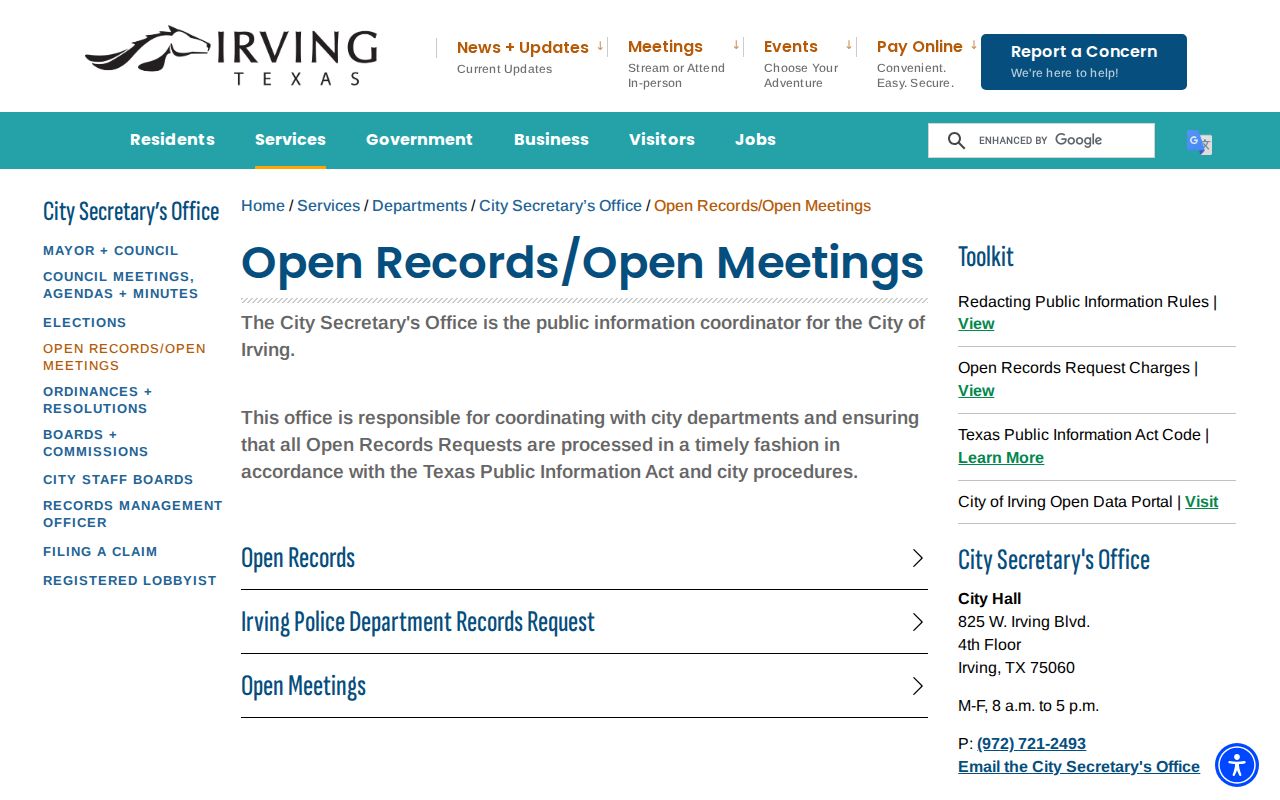
The image reinforces the key Irving rule: an IPD record follows the city's police request channel, not the Dallas County Sheriff request form.
The Irving Police Department
Irving Police creates offense reports, arrest reports, evidence references, officer narratives, and related incident material for events its officers handle. Those police records can include names, dates, locations, an alleged offense, and the officer's account, subject to lawful redaction. An arrest report is not the same file as an Irving booking record or a later court case. Each has a different custodian and may use a different identifier.
Some Irving police information may be withheld or released with confidential details removed. Active-investigation material, juvenile information, protected victim identifiers, personal financial data, and other information made confidential by law do not become public merely because a written request was filed. The Irving page links separate police confidentiality information. When part of a report is protected, the city may release a redacted version or use the Texas Attorney General process to address an asserted exception.
Note: A police narrative records an allegation and officer activity; it does not establish a conviction or final Irving court outcome.
Irving Airport-Area Police Records
Irving's place between Dallas and DFW Airport creates a local trap for record searches. A highway, airport, or transit-area event near Irving is not automatically an Irving Police record. DFW Airport has its own police, Texas DPS troopers can create highway reports, DART Police handles transit-system incidents, and a federal agency may control its own material. City boundaries alone do not identify the custodian.
Start with the badge, agency name, report heading, citation, or property receipt. If it says Irving Police, use the Irving request form. If another agency appears, send the request there. This small check can save days of misrouted correspondence and prevents a false conclusion that no record exists. The same rule applies when a crash record belongs in the official TxDOT CRIS channel rather than an Irving criminal history file.
Arrests and Bookings in Irving
An Irving arrest can generate several records within hours. IPD makes the arrest report. A detention office creates custody and intake data, including a booking identifier, time, alleged booking charges, bond or hold information, fingerprints, and a custody location. A magistrate then creates warnings and bond records. If a prosecutor files a higher-level charge, a Dallas County clerk opens the court file.
Irving may initially detain a person, but the Dallas County jail channel is the correct public locator after transfer to the Lew Sterrett Justice Center. Search by legal name or booking number, then call Dallas County inmate information at (214) 761-9025 if the result is unclear. A record can disappear from a current-custody search after release or transfer. That does not mean the Irving police report or court record was erased.
For more county-level detail, the Dallas County arrest history resource explains the jail, agency-request, and court channels without treating an arrest as proof of guilt.
Finding Irving Arrest Records After Transfer
When an Irving custody result is gone, follow the record rather than repeating the same name search. First request the Irving Police report through the city form. Next check Dallas County court history after a prosecutor has had time to file. If the person was booked at Lew Sterrett, use the county inmate line or request releasable booking material from the Dallas County Sheriff. The police report and booking file remain separate even when both describe the same arrest.
Charges can change at each step. The offense named by an Irving officer may differ from the booking label, and the prosecutor may file a different charge or none at all. The signed judgment or final docket entry is the best source for disposition. If the event later appears in the Texas DPS repository, remember that agencies submit the data and a disposition can lag. A fingerprint-based personal review is the sound route for correcting your own identity-linked state record.
Irving Municipal Court Records
The Irving Municipal Court controls city ordinance matters, fine-only cases, citation settings and payments, and Irving municipal warrants. It is not the clerk for Class A or B misdemeanors or felonies. Those higher-level cases move into Dallas County's County Clerk or District Clerk systems. Searchers should use the court named on the citation rather than treating every Irving case as a county case.
The research confirms the official court route but does not publish a full copy-fee schedule or every online field. Contact the Irving Municipal Court through its official page for current access and copy instructions.
| Court Name | Irving Municipal Court |
|---|---|
| Case Types Heard | City ordinance violations, fine-only matters, citations, and municipal warrant proceedings |
| Case Lookup Channel | Official municipal court page and the court clerk's current service channels |
| What the File Shows | Case or citation identifier, settings, plea and disposition entries, payment status, and warrant information when public |
| Copies & Fees | Request current record-copy terms from the municipal court; no verified Irving fee schedule was in the reviewed source |
Irving Citation or County Criminal Case
The charge level sets the court path. Irving Municipal Court handles Class C and other fine-only matters within its authority. Dallas County Criminal Courts handle Class A and B misdemeanors. District and Criminal District Courts handle felony prosecutions. A city citation number therefore may produce no result in the county portal, while a Dallas County cause number may not belong in an Irving municipal search.
Read the issuing court and charge class on the paperwork. A municipal warrant should be checked with Irving Municipal Court. A county felony or misdemeanor warrant belongs with the relevant county clerk and Dallas County Sheriff's warrant line at (214) 761-9026. State law-enforcement networks are not a public statewide warrant database, so an absent web result should never be treated as proof that no warrant exists.
- Citation number
- An identifier tied to the Irving municipal matter.
- Cause number
- The identifier assigned to a filed court case, including a Dallas County prosecution.
- Capias
- A court writ directing arrest; a capias pro fine concerns enforcement after judgment in a fine-only case.
Where Irving Records End Up
Records do not all leave Irving at once. IPD retains its incident and arrest report. A city citation remains with Irving Municipal Court. If an Irving arrest supports a higher-level prosecution, the prosecutor's filing creates a Dallas County case. Fingerprints and later court submissions can also feed the Texas DPS Computerized Criminal History system.
Record flow: Irving Police Department › Dallas County Courts › Texas Department of Public Safety
That flow explains why timing changes the best place to look. A very recent Irving event may appear only in police or custody records. After filing, the county court docket becomes the source for charges, settings, pleas, and disposition. DPS offers a statewide public conviction and deferred-adjudication slice after agencies report the data. It is not a substitute for the full Irving report or signed county judgment.
Irving Report Numbers and Court Records
An IPD report number identifies the police event. It does not search as a Dallas County cause number. A booking number identifies the custody episode, while a citation number points to the municipal matter. These identifiers may be cross-referenced later, but each began in a different system. Keep all numbers from Irving paperwork and state which one you are providing when speaking with a records office.
A useful record check compares the fields rather than trusting a name alone. Match the full name, date of birth where lawfully displayed, event date, agency, charge description, court, and final disposition. Similar names can yield a false match. Texas DPS specifically warns that names and dates of birth do not positively identify a person; fingerprints are the reliable identity link for review of your own state history.
Irving City Records Beyond Police
The Irving City Secretary coordinates general city requests at City Hall, 825 W. Irving Boulevard, fourth floor, Irving, TX 75060. The office is open Monday through Friday from 8 a.m. to 5 p.m. and can be reached at (972) 721-2493. That channel is useful for existing city records outside the police request workflow.
Choose the channel by custodian. An IPD report belongs on the Irving Police form. A municipal judicial record belongs with Irving Municipal Court. A general administrative city record may go to the City Secretary. A Dallas County court or jail record goes to the county office that holds it. Sending one request to every office does not create a combined Irving criminal record and can slow the search.
Irving City Secretary
825 W. Irving Boulevard, fourth floor
Irving, TX 75060
(972) 721-2493
Monday-Friday, 8 a.m.-5 p.m.
Public Access Rules for Irving Records
The Texas Public Information Act applies to executive-branch city records, but it does not make every detail public. Irving can redact information made confidential by law and may seek an Attorney General ruling when it asserts an exception. Judicial records follow court rules and other law rather than the ordinary TPIA process. State criminal-history dissemination has its own limits, and sealed or expunged matters are intentionally absent from ordinary public channels.
Describe the existing Irving record with care. A request for a named report, date range, video, or citation is more workable than a demand that staff answer questions or perform legal research. Public access does not change the meaning of the record. An arrest remains an allegation unless a court enters a conviction.
Key Statutes:
Texas Public Information Act, Government Code Chapter 552 - City records are presumed available unless a law makes them confidential or permits withholding.
Government Code Sections 411.083 and 411.135 - Texas limits criminal-history dissemination while authorizing public access to specified conviction and deferred-adjudication data.
Texas Rules of Judicial Administration Rule 12 - Judicial records use court access rules rather than the ordinary city public-information process.