
Criminal Cases in the Dallas County Courts
Dallas County divides criminal court files by charge level. District Courts and Criminal District Courts hear felony cases, while County Criminal Courts handle Class A and B misdemeanors. The county reports 17 felony courts and 14 misdemeanor courts. Their main work is centered in the Frank Crowley Courts Building. Fine-only state-law violations and city ordinances belong to municipal or Justice of the Peace courts, so those cases will not always appear through the county criminal portal.
The custodian changes with the court. The Dallas County District Clerk holds felony case records. The Dallas County Clerk holds misdemeanor records. Municipal and justice courts retain their own dockets and warrants. A reliable search therefore starts with the alleged charge level and issuing court, not just a name. Case numbers and court codes help separate similar names and direct a copy request to the office that owns the original Dallas County criminal case file.
Using Dallas County Case Search
The free Dallas County Criminal Background Search covers felony and misdemeanor court histories from 1975 forward and does not require registration. It is an index for discovery, not a full identity match. Search by name when the case number is unknown, then narrow common-name results with middle name, date of birth, race, sex, pending status, or other available fields. A case number is the most precise route when it is already known.
The county's court documents portal adds public case information and, where available, document images. The manifest source for that portal is shown below.
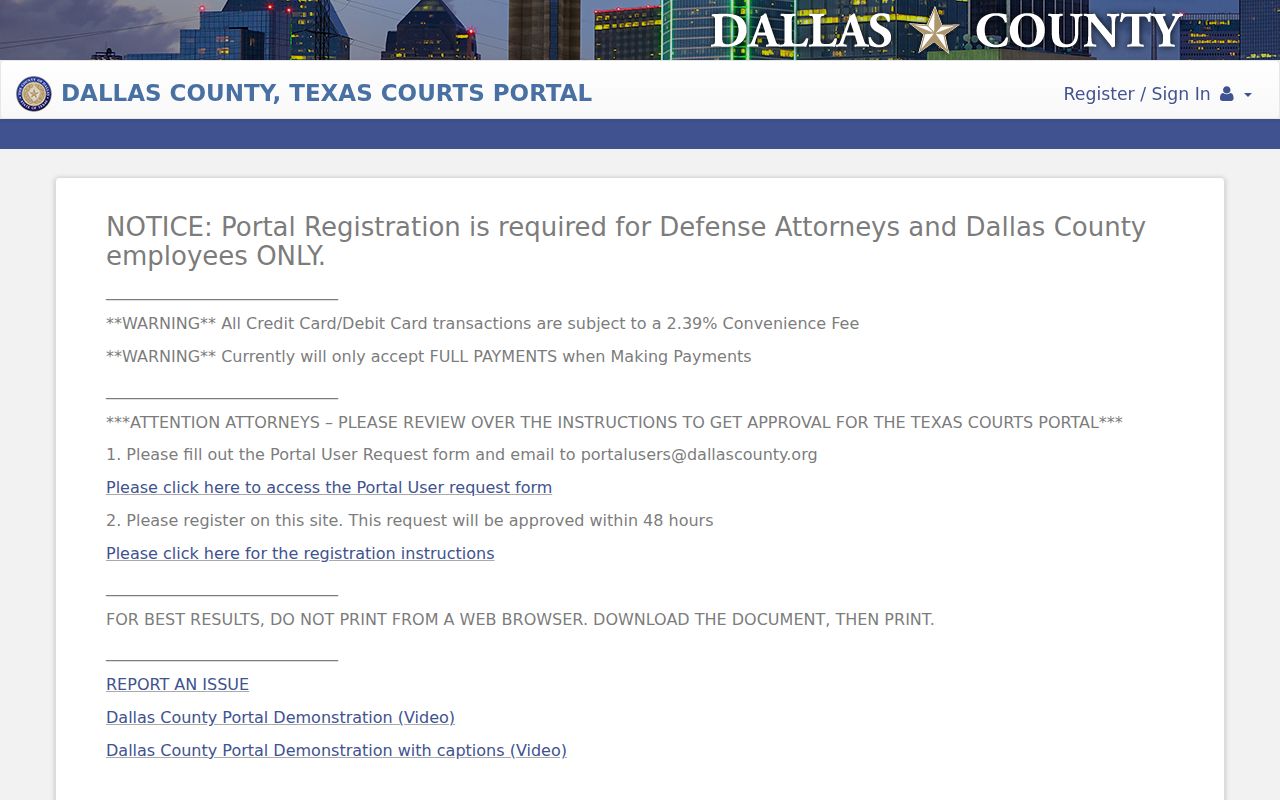
That second layer helps distinguish a bare index hit from the docket entries and public filings that explain what happened in court.
How to Search Case Records
A Dallas County case search works best as a chain. Start online, verify the court and status, then contact the proper clerk when the signed filing or a certified copy is needed. The free county search is the practical first stop because statewide re:SearchTX coverage depends on local integration. The following steps cover both remote and clerk channels.
- Open the free county search and choose name or case-number mode. Use exact spelling first, then add the available identity filters.
- Open the matching case and confirm its court, case number, charge, filing date, and status before relying on any docket entry.
- Check the Dallas court documents portal for public images. Document coverage varies, and protected material is not posted.
- For a felony file, contact the District Clerk Felony Records Desk by email, mail, phone, or at its second-floor counter. For a misdemeanor, use the County Clerk criminal-records counter or Central Records.
- Ask for the exact judgment, charging paper, docket sheet, or certification needed. Use re:SearchTX only as a statewide fallback and confirm Dallas material with its originating clerk.
These are the fields documented for the Dallas County name and case-number search:
| Field Label | Type | Required | Options or Notes |
|---|---|---|---|
| Search By Name / Case Number | Tabs | One mode | Primary search control |
| Last Name | Text | Yes in name mode | Exact spelling is the best start |
| First Name | Text | No | Narrows matches |
| Middle Name | Text | No | Narrows matches |
| Name Type | Dropdown | Unspecified | Live options are portal supplied |
| Race / Sex | Dropdowns | No | Optional narrowing fields |
| DOB Month / Day / Year | Date fields | No | Helps distinguish common names |
| Number Type | Dropdown | No | Paired with an identifier |
| Pending | Dropdown | No | Filters by pending status |
| Case Number | Text | Yes in case mode | Use the local case identifier |
Dallas County Clerk Custodian Split
The felony and misdemeanor counters sit near each other, but their records are not interchangeable. The District Clerk Felony Records Desk is on the second floor at 133 N. Riverfront Boulevard. It accepts felony record and copy requests at DCRecordsCriminal@dallascounty.org and by phone at (214) 653-5950. The current felony form provides for in-person, mail, and email submission. A name and date-of-birth search costs $5, with copies or certification requested separately.
Across the hall, the County Clerk serves Class A and B misdemeanor files. Its criminal courts FAQ documents search, copy, fee, and archive routes. The manifest image tied to that official source appears below.
The County Clerk charges $5 for a name and date-of-birth search, $1 per plain-copy page, and $5 per case for certification or exemplification in addition to copy charges.
What the Case File Shows
A Dallas County criminal case file records what prosecutors filed and what the court did. It can show an indictment, information, or complaint, followed by settings, motions, pleas, rulings, disposition, judgment, and sentence. It is different from an arrest report. The booking charge can change before filing, and a court outcome must be read from the judgment or other final entry.
| Case Number & Court | Identifies the cause and the Dallas County court that owns the file. |
|---|---|
| Parties & Counsel | Lists the State of Texas, defendant, and attorney where entered. |
| Charging Document | Shows the filed allegation, statute, count, degree or class, and alleged date. |
| Docket Entries | Chronological record of filings, motions, settings, pleas, and court action. |
| Bond | May show amount, type, status, and linked warrant or capias events. |
| Disposition & Judgment | Records dismissal, acquittal, deferred adjudication, or conviction and the signed result. |
| Sentence & Conditions | May state confinement, community supervision, fines, costs, restitution, and other terms. |
Public financial fields may show fines, costs, or balances, but the criminal background index is not a full cashier ledger. Document images also vary by filing date and access rules.
Reading Dallas County Court Codes
Dallas County uses short codes to identify courts and case processing. MA through MC point to County Criminal Courts 1 through 3. ME through MG cover County Criminal Courts 4 through 6. FH through FL and FX through FY identify Criminal District Courts 1 through 7. FP, FQ, FR, FS, FT, and FU refer to six numbered Judicial District Courts. These codes guide readers to the proper clerk, but they should be checked against the county's current table.
The official Dallas court and disposition-code reference also defines processing codes such as CRTC and MISC. Its assigned source image follows.
A code is a routing clue, not the final result. Confirm the outcome against the docket and signed judgment, especially when a converted or older entry is unclear.
- Pending
- The Dallas County criminal case has not reached a final disposition.
- Dismissed
- The charge ended without conviction, but the term does not mean acquittal or automatic record removal.
- Deferred adjudication
- Supervision without an immediate finding of guilt; successful completion can avoid conviction, while public history may remain unless relief applies.
- Acquittal
- A not-guilty outcome after adjudication.
Stages of a Criminal Case
Once the District Attorney files a charge, the Dallas County court record grows event by event. Arraignment presents the charge and addresses a plea. Pretrial entries can record motions, settings, discovery disputes, bond action, or a negotiated resolution. A plea or trial leads toward disposition. If conviction follows, the judgment and sentence become the key final records. Not every case passes through each stage in the same way, and the docket may contain resets or amended charges.
Case flow: Charges Filed › Arraignment › Pretrial › Plea or Trial › Disposition › Sentencing
Arrest and booking precede that court flow but are held by law-enforcement and jail systems. Readers tracing the earlier custody event can use the Dallas County arrest history page, while the case file remains the source for filed charges and the outcome.
Older Dallas County Case Files
The free Dallas County index reaches back to 1975, but that does not mean every filing is online. Most felony documents after 2009 and misdemeanor plain copies after 2011 are the practical document-image coverage. A record may therefore have an online index entry with no downloadable judgment or charging paper. The proper response is to keep the case number and contact the responsible clerk rather than assume the file does not exist.
Pre-2009 felony files require at least three to five business days for retrieval under the current request form. Older misdemeanor records may be stored offsite and can take up to 72 hours. Requests submitted to the felony desk after 4 p.m. begin processing the next business day. Give the clerk the subject name and date of birth, case number if known, and the exact document sought. That detail prevents a broad search from standing in for a precise Dallas County court-record request.
Note: An index coverage date describes searchable entries, not guaranteed online access to every paper filed during that period.
Access & Restrictions
Texas court records are not ordinary executive-branch records under the Texas Public Information Act. Judicial access rests on court rules and other law, including Texas Rules of Judicial Administration Rule 12. Dallas County suppresses sealed and confidential cases from public portals. It also does not post records that identify children or sexual-assault victims. Social Security numbers, protected financial data, and other confidential identifiers are redacted.
If a public case does not appear, ask the correct clerk whether it is held offsite, restricted, filed under a different number, or absent because of a data issue. Do not ask staff to conduct legal research. Request an existing docket, filing, judgment, or certified copy. The statewide platform can provide another search layer, but local integration limits make the Dallas clerk the final source for a Dallas County criminal court file.
The manifest also assigns the official re:SearchTX statewide court platform source to this topic.
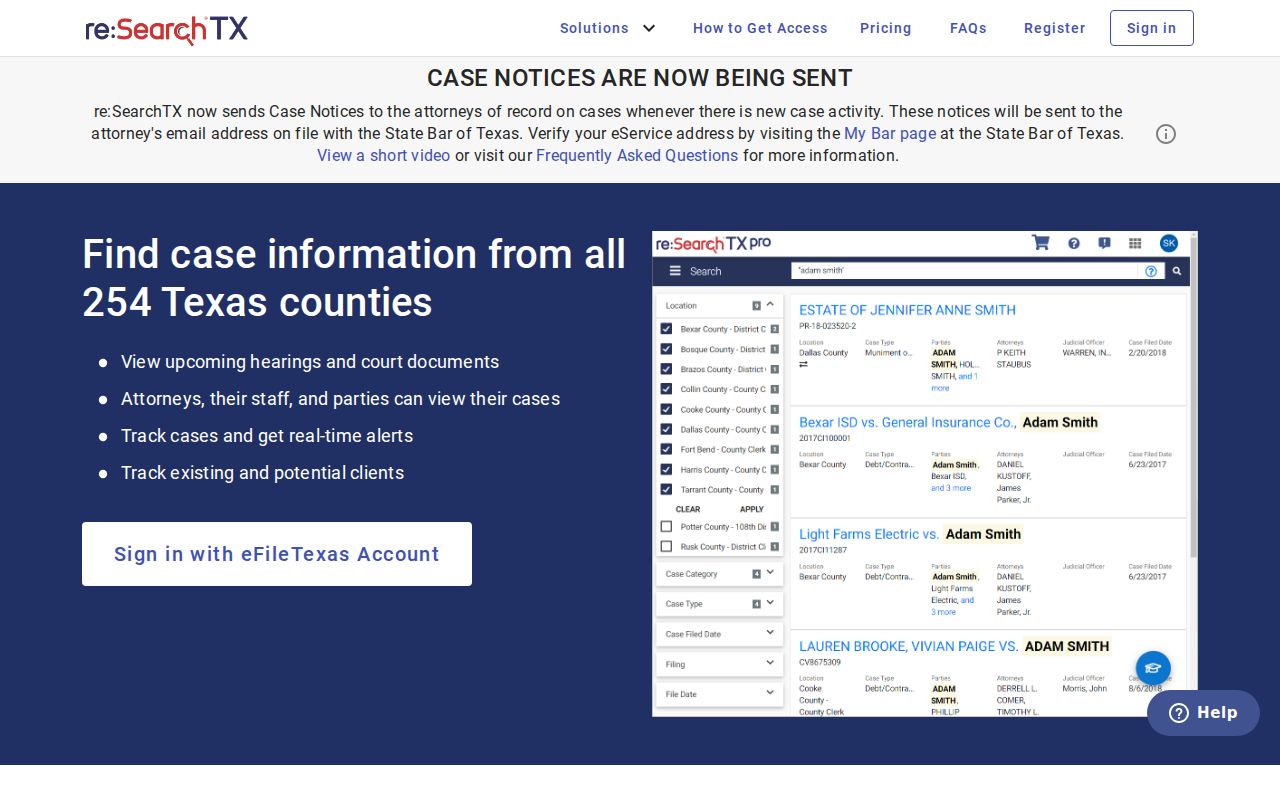
Use its statewide reach as a cross-check, then verify the Dallas County docket and document with the office that maintains the original.
Odyssey and Dallas County Dockets
Dallas County replaced a felony mainframe dating to 1976 with Odyssey in May 2023. More than 2.3 million felony cases dating to 1968 were converted. That change made a vast body of older data part of the newer system, but the District Clerk has also acknowledged conversion errors that affected reporting. The milestone explains why an old electronic code, date, or activity line may need more care than a recent entry.
When converted data and the paper result disagree, the signed judgment and clerk-held filing matter most. Keep a copy of the questionable screen, note the case and court numbers, and ask the felony desk for the exact source document. If a statewide DPS history also lacks a court outcome, a fingerprint-based personal review and the DPS correction process address the repository record. That is a separate task from correcting a Dallas County docket.
Note: Converted data are useful search leads, but the Dallas County clerk's source filing remains the record to verify.