
How to Check Criminal History in Dallas County
Begin with the free Dallas County Criminal Background Search when the goal is to find local felony or misdemeanor case history. It indexes county cases from 1975 forward and does not require an account. A name can uncover likely cases, while a known cause number gives a cleaner match. The index is not the same as a certified file, a current custody roster, or a statewide fingerprint record. Decide which proof is needed before ordering a copy.
The Dallas County government home page is the official department starting point.
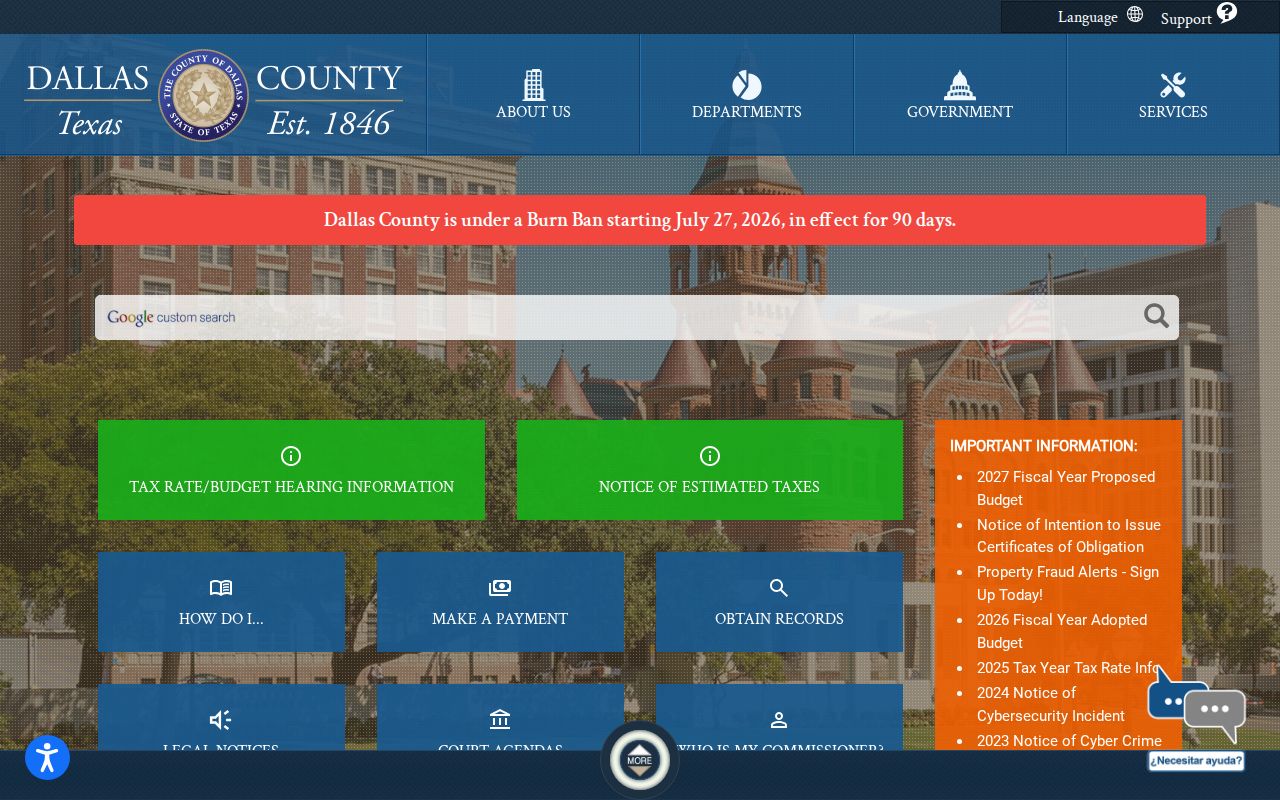
Its department links help route a Dallas County criminal record question to the clerk, sheriff, probation office, or another record custodian.
- Search the free county case index by last name, then add first name, middle name, birth date, race, or sex to narrow a common-name result.
- Open the matching cause number and compare the court, filing date, charge, and status instead of relying on the name alone.
- Use the Dallas County court documents portal for public docket information and available images. Protected or older files may require a clerk request.
- Check the sheriff's jail channel only when present custody or booking matters. It does not supply the final case outcome.
- Ask the proper clerk for a plain or certified copy, or use Texas DPS when a statewide repository result or fingerprint-linked personal review is needed.
Dallas County Criminal Case Search Fields
The county form offers two routes. Name mode is useful for discovery, but case-number mode is more exact. A person with a common name should use every reliable identifier already known and should never treat a similar name as proof. The county warns that online data can change and may not be complete or current.
The Dallas County record-search hub shows the official choices for felony, misdemeanor, civil, family, and probate material.
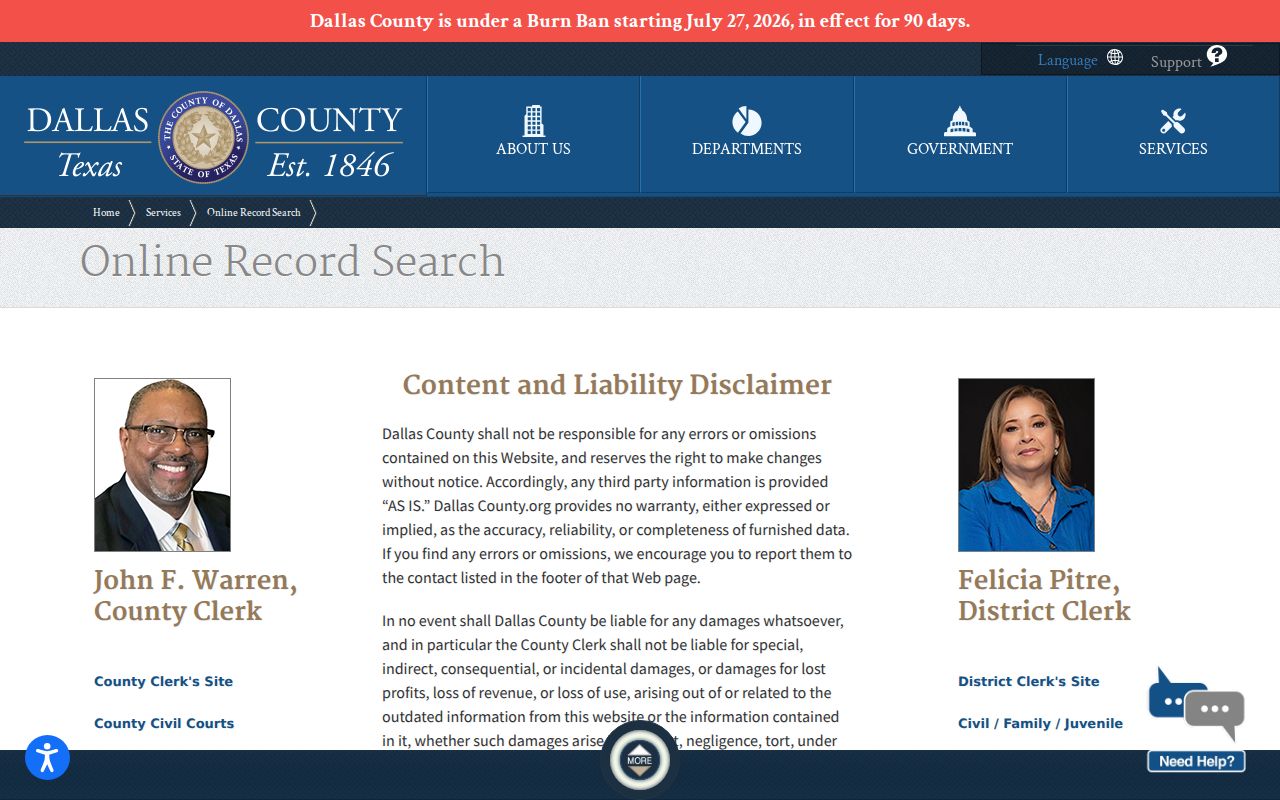
The separate paths matter because criminal cases have different custodians from other court records.
| Field | Use | What to know |
|---|---|---|
| Last name | Name search | Required in name mode; begin with the exact legal spelling. |
| First and middle names | Narrowing | Optional fields help separate similar Dallas County records. |
| Date of birth | Identity check | Month, day, and year can be entered separately. |
| Race and sex | Narrowing | Optional portal filters, not proof of identity by themselves. |
| Pending | Status filter | Limits results based on the portal's current status data. |
| Case number | Exact lookup | Required in case-number mode and usually the best key. |
The free felony and misdemeanor search interface is the county's direct name and case-number tool.
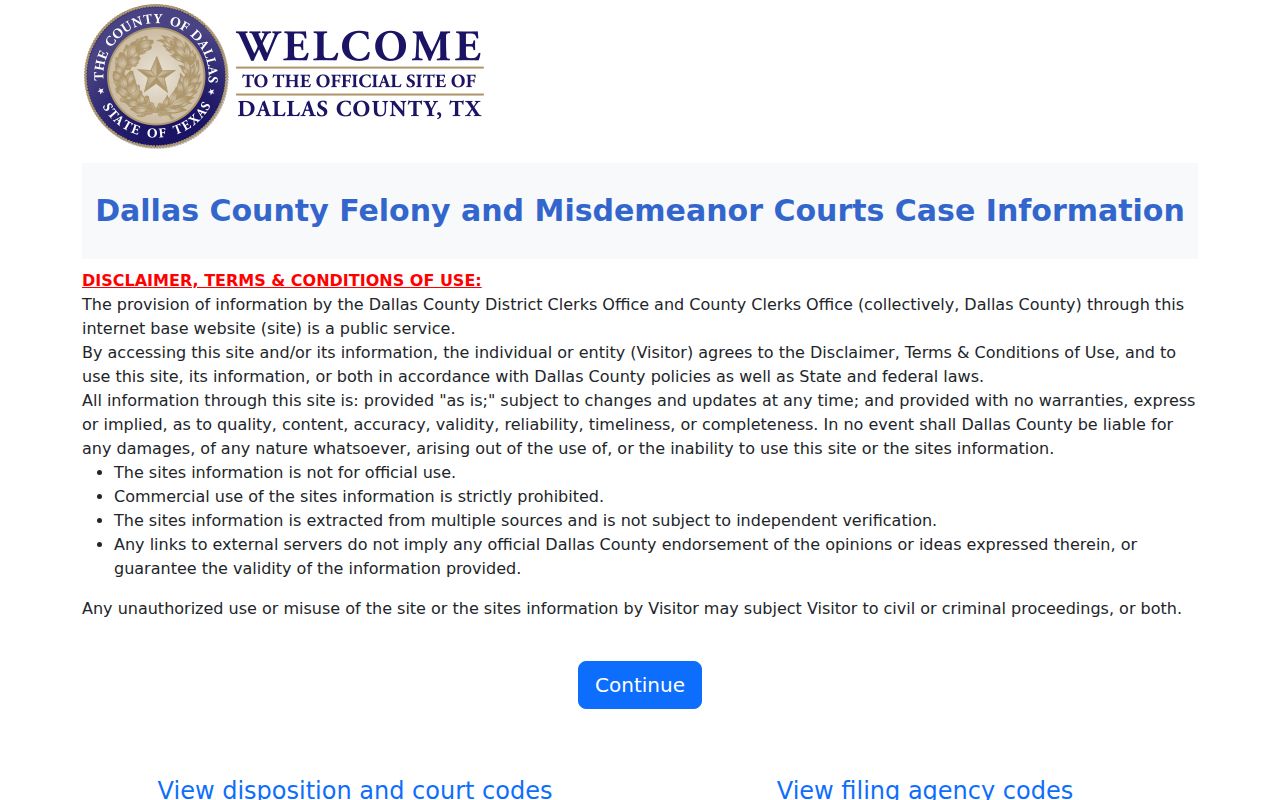
Use its result as a locator, then confirm the disposition and any needed document with the clerk's file.
Official Texas Background Checks
Texas Department of Public Safety, Crime Records Division, maintains the Computerized Criminal History repository. Its public name product can return Texas convictions and deferred adjudications reported to DPS. The public search uses prepaid credits. One credit costs $1, a no-match search still consumes a credit, and card purchases carry the stated processing charge. A name and date of birth do not positively identify a person.
For a review of one's own identity-linked Texas record, DPS directs the person to Texas FAST fingerprint capture through IdentoGO by IDEMIA. Research current to August 2026 lists $15 for the DPS fingerprint record check and a $10 FAST fingerprint fee, but the scheduled transaction should control. An FBI Identity History Summary is also subject-only and serves a different national purpose. Neither product replaces a certified Dallas County judgment.
The Texas DPS criminal-history instructions explain account credits, match limits, and retained search data.

Those warnings are why a Dallas County case number and signed judgment remain vital checks on a name result.
Dallas County Records or Texas DPS
The free county index and the paid state search answer different questions. Dallas County shows cases filed in its felony and misdemeanor courts. DPS shows the public portion of statewide conviction and deferred-adjudication information sent by Texas agencies. A recent county case may appear locally before its disposition reaches the state repository. A city citation may stay in municipal court and never belong in the county felony and misdemeanor index.
The Texas DPS public search portal is the official statewide name-search entry point.
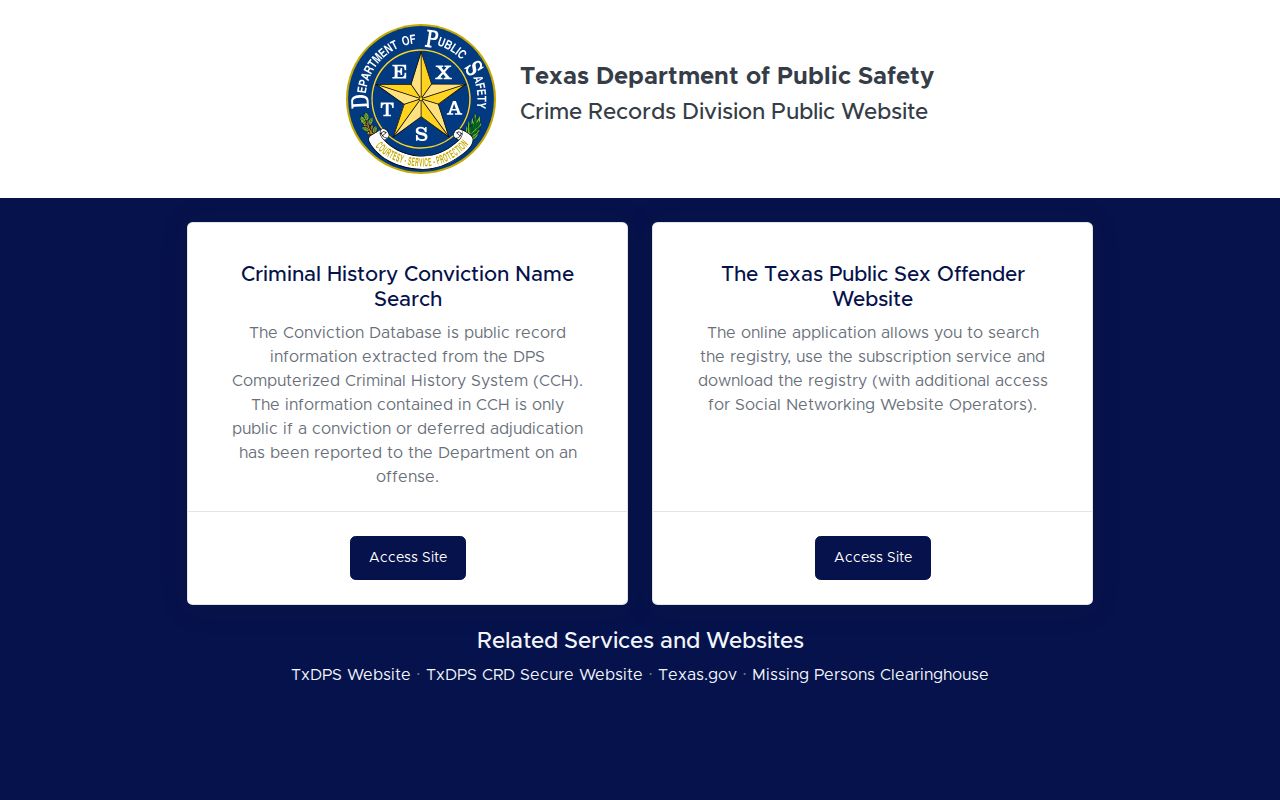
Use DPS for its statewide repository slice, but use Dallas County clerks for the pleadings, docket, judgment, and certified case record.
| Channel | Best use | Main limit |
|---|---|---|
| Dallas County index | Local felony and misdemeanor case discovery | Not statewide and not a fingerprint identity match |
| Texas DPS name search | Public statewide convictions and deferred adjudications | Name-based and dependent on agency reporting |
| FAST personal review | Reviewing one's own identity-linked Texas history | Requires fingerprints and the DPS process |
Types of Criminal Records
One Dallas County event can create records at several offices. The officer writes an incident or arrest report. Lew Sterrett staff create the booking file. Prosecutors decide what charge to file, and the clerk opens the case. Fingerprints connect the arrest cycle to DPS. The court later reports a disposition. Each record has its own purpose, update path, and access rule.
The Dallas County Sheriff's Office is the official source for sheriff services and custody routes.

The sheriff does not hold every police report in Dallas County. Request a Dallas, Irving, Garland, DPS, transit, campus, or constable report from the agency that wrote it.
- Incident and arrest report: the generating police or sheriff agency holds the narrative and officer-created event details.
- Booking record: the jail holds book-in time, facility, initial charges, bond, and custody data.
- Court case file: the District Clerk holds felony files, while the County Clerk holds Class A and B misdemeanor files.
- CCH entry: Texas DPS assembles fingerprint-linked arrest cycles and reported outcomes.
- Warrant, supervision, prison, and registry records: the issuing court, CSCD, TDCJ, or DPS registry holds the relevant slice.
Dallas County Criminal Records Crossroads
Frank Crowley Courts Building is the main public crossroads at 133 N. Riverfront Boulevard. The District Clerk Felony Records Desk sits on the second floor and is open Monday through Friday, 8:00 a.m. to 4:30 p.m.; its records number is (214) 653-5950. The County Clerk misdemeanor counter is across from it, with questions routed to (214) 653-5767 or (214) 653-5762.
The Dallas County District Clerk posts felony records access and current Odyssey notices.
The building stacks record creators in one complex: clerk counters below, criminal courtrooms above, CSCD and specialty programs on the eighth and ninth floors, and District Attorney functions higher up. Close proximity does not merge custody. Each office still controls its own record.
The Frank Crowley floor directory identifies the public counters and justice offices.
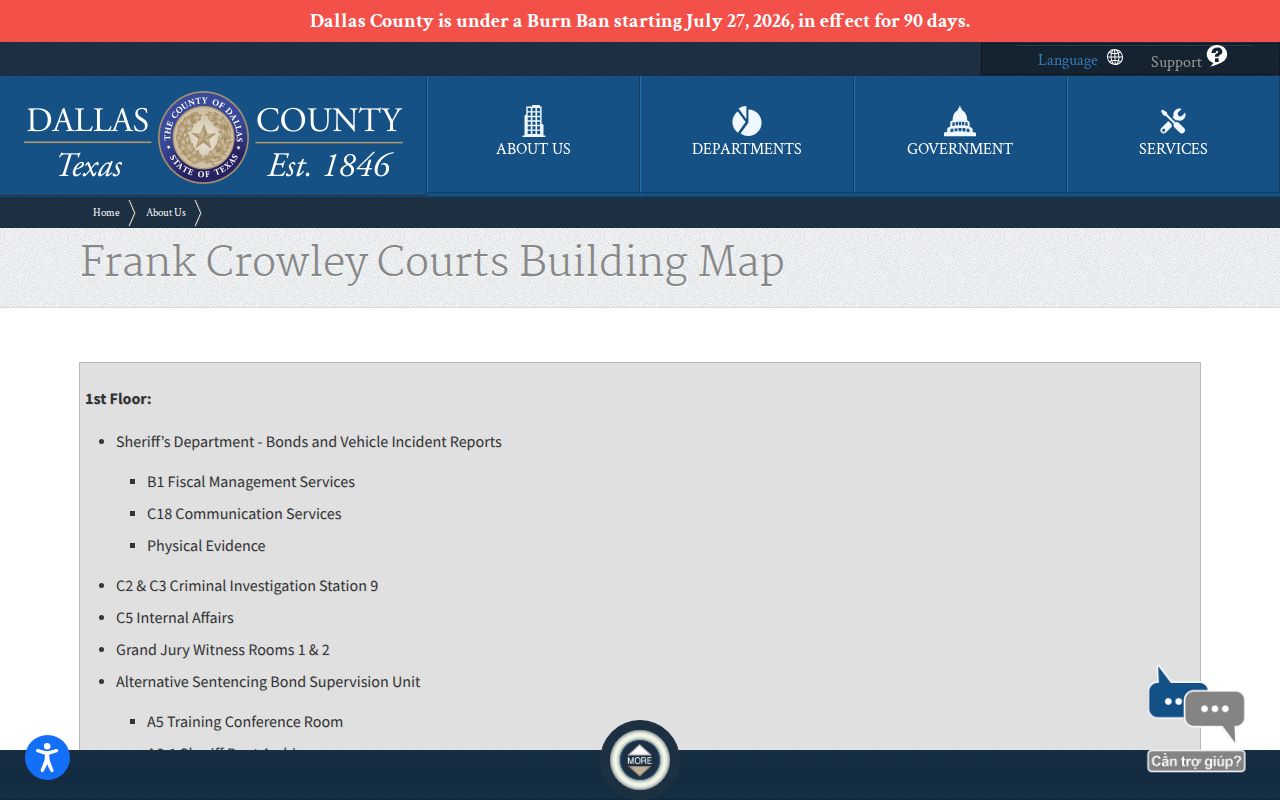
That floor plan helps explain why a single Dallas County prosecution produces separate clerk, court, prosecutor, defense, and supervision records.
What a Dallas County Criminal Record Shows
Read the heading and custodian before reading the fields. A court file may show the cause number, court, attorneys, filing date, charges, settings, pleas, disposition, judgment, sentence, bond, and public documents. A booking profile instead centers on the booking number, intake time, custody status, facility, initial charge, and bond. DPS CCH can connect arrest cycles with agency submissions and reported outcomes.
| Name and identifiers | Names, aliases, birth data, and identity numbers where the system is authorized to display them. |
|---|---|
| Arrest and booking | Agency, date, booking number, custody location, initial allegation, and bond data where set. |
| Charges and statutes | Filed offense text, count, degree or class, and cited Texas law. |
| Disposition | Pending, dismissed, acquitted, deferred, or convicted status as entered by the court. |
| Sentence | Confinement, fine, restitution, or community-supervision terms shown in the judgment. |
| Custody or supervision | County custody, TDCJ status, probation, or parole data held in different systems. |
- Disposition
- The court's outcome, which is not the same as the charge listed at booking.
- Deferred adjudication
- Supervision without an immediate finding of guilt; the event may remain public unless legal relief applies.
- Capias
- A court writ directing an arrest, sometimes used after a missed setting or to enforce a judgment.
- Nondisclosure
- A Texas order that limits public disclosure while preserving access for agencies named by law.
Dallas County Jail Records Explained
Lew Sterrett Justice Center at 111 W. Commerce Street is the county booking and local custody complex. Its Intake/Release Center works with North Tower, West Tower, and Suzanne L. Kays facilities. Inmate information is available at (214) 761-9025. A booking result proves that jail staff processed a person into custody. It does not prove guilt, and it may disappear after release or transfer.
When a person moves to state prison, switch from the county lookup to the TDCJ Inmate Information Search.
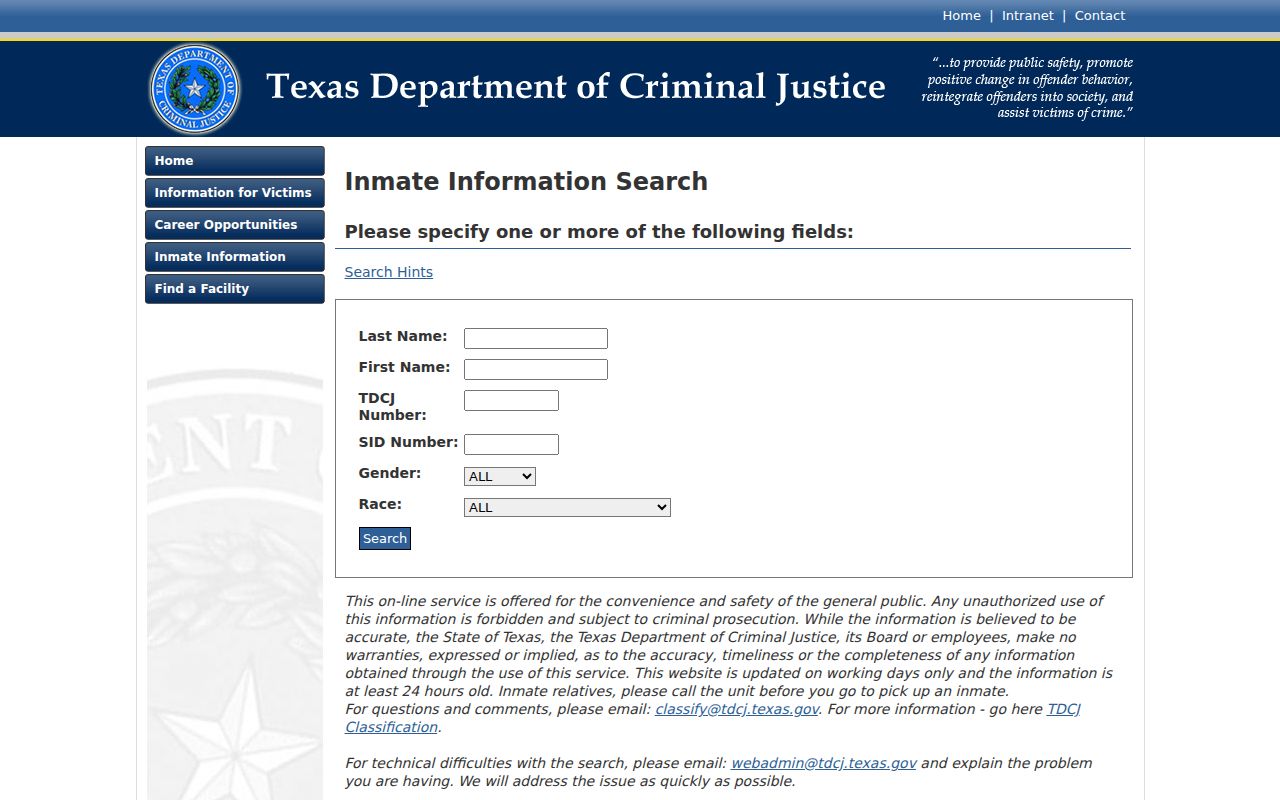
TDCJ covers sentenced state custody and displayed supervision status, not a person still held in the Dallas County jail. Federal custody uses the Bureau of Prisons locator instead.
For a sheriff-created report or releasable booking material, Dallas County accepts written requests through GovQA, email at SheriffOpenRecords@dallascounty.org, fax at (214) 653-3420, mail, or the first-floor sheriff counter at Frank Crowley. The form asks for a clear description with names, dates, times, and places. Copy, media, or postage charges may apply after an estimate. Free inspection can be discussed at (214) 653-3453.
Public Access Laws
The Texas Public Information Act governs executive-branch records such as releasable agency reports. Judicial records follow court rules and other law instead of the TPIA alone. A sound request asks the office for existing records and supplies enough facts to locate them. The ten-business-day Attorney General process is not a promise that every record will arrive within ten days.
Key Texas laws:
Government Code Chapter 552 creates the TPIA access framework and its exceptions.
Government Code Chapter 411 controls criminal-history dissemination and authorizes the public DPS conviction product.
Code of Criminal Procedure Chapter 55A sets current Texas expunction paths.
Code of Criminal Procedure Chapter 62 governs sex-offender registration and public registry data.
Confidential material may be redacted while the balance is released. Juvenile information, sealed matters, protected victim or child identifiers, medical data, and grand-jury deliberations have special limits. Public access never authorizes threats, harassment, or other misuse.
Dallas County Warrant Record Channels
Warrant checks split by issuing court. A county felony or misdemeanor warrant may appear through Dallas County Wanted, the clerk's case, or the sheriff's system. Verify a public hit with the dedicated Warrant Information line at (214) 761-9026 because entry or clearance can lag. A municipal warrant belongs with the municipal court in Dallas, Irving, or Garland. Justice court warrants stay with the issuing precinct.
Texas does not offer TCIC or NCIC as a general public statewide warrant search. A written sheriff request can seek releasable warrant material, but it should not delay action on a known court setting. Confirm the case number, issuing court, bond instructions, and current status with that court. Do not arrive at a jail based only on an unverified web match.
Terms also matter. A bench warrant or capias can follow a missed setting or a claimed supervision violation. A capias pro fine concerns enforcement after judgment in a fine-only case. The right office depends on the court named on the record.
Sealed, Expunged & Restricted
Expunction and nondisclosure are different Texas remedies. A qualifying expunction under Chapter 55A directs listed custodians to remove and generally destroy or return the records covered by the order. An order of nondisclosure limits ordinary public access but keeps the record available to entities authorized by Government Code Chapter 411. A dismissal or successful deferred adjudication does not erase a record by itself.
| Record service | Published amount or process |
|---|---|
| County Clerk misdemeanor name and DOB search | $5 |
| District Clerk felony name and/or DOB search | $5 |
| County Clerk plain copy | $1 per page |
| County Clerk certification or exemplification | $5 per case plus copy costs; other certification may apply |
| Online public case information | Free |
| Texas DPS public name search | $1 credit plus the stated card surcharge |
Eligibility and timing depend on the arrest, charge, result, prior history, limitations period, and related charges. A Dallas County filing should identify each custodian that holds part of the event, such as the clerks, sheriff, District Attorney, DPS, CSCD, TDCJ, and re:SearchTX where applicable. Current Chapter 55A forms matter because Texas recodified the former expunction chapter effective in 2025.
Fixing Dallas County Record Gaps
A missing or unclear result should be traced through the original record chain. First compare the county docket with the signed judgment. Ask the felony District Clerk or misdemeanor County Clerk to explain a local code and obtain the filed disposition. Then review the relevant DPS entry. For errors in one's own state history, DPS directs users to its fingerprint-based personal review and error-resolution process at (512) 424-7256.
Older electronic cases deserve extra care. In 2023 the District Clerk replaced a mainframe dating to 1976 and moved 2,314,823 felony cases, including data back to 1968, into Odyssey. The clerk has acknowledged conversion-data issues. That is a reason to verify an old code against the paper or imaged judgment, not a reason to assume the case never existed.
Dallas County also reports different online document windows. Many felony documents filed after 2009 and misdemeanor plain copies from 2011 forward are the practical online range. Earlier files may require retrieval. The felony form calls for at least three to five business days for pre-2009 files; older misdemeanor records may take up to 72 hours from storage.
Dallas County Probation and Parole Records
Dallas County Community Supervision and Corrections Department runs court-ordered probation. TDCJ Parole Division supervises people released from state prison, while the Texas Board of Pardons and Paroles makes release decisions. These systems are not interchangeable. A court judgment is the best public source for an imposed probation term, and TDCJ may display a state custody or parole status.
The Dallas County CSCD office publishes its contacts, programs, and county supervision role.
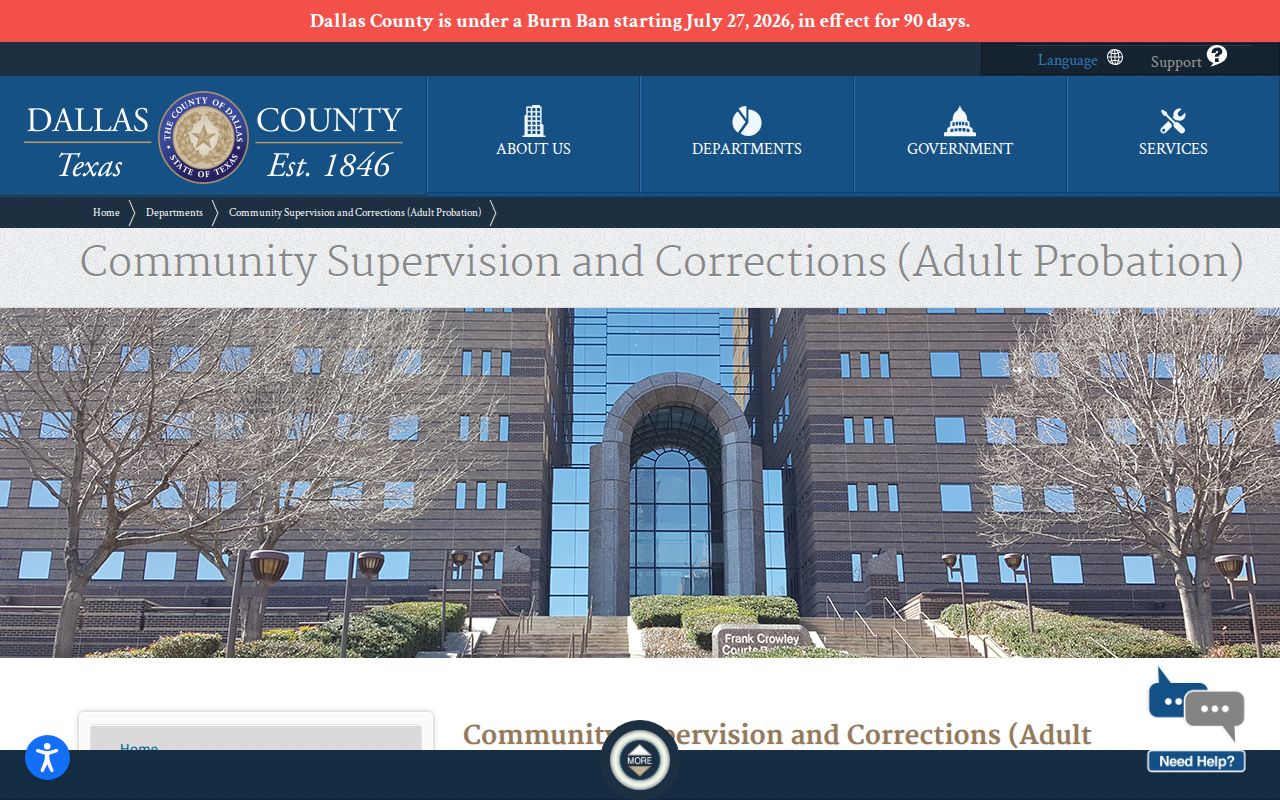
CSCD administration is at 1300 W. Mockingbird Lane, third floor, Dallas, with a main number of (214) 653-5300. Operational notes, treatment details, and officer information may remain confidential.
Named Dallas County programs can affect the record outcome. The SET mental-health program states that successful completion can lead to dismissal and expunction. The District Attorney's Pre-Trial Intervention tracks may lead to dismissal under the agreement. Still, dismissal is the court outcome and expunction is a separate legal process.
Criminal Records by City in Dallas County
City agencies add another layer to Dallas County criminal records. Dallas Police, Irving Police, and Garland Police each control reports their officers created. Their municipal courts hear city ordinance and fine-only cases, including municipal warrants. A Class A or B misdemeanor or felony moves through the county clerk system, and a transfer to Lew Sterrett moves custody lookup to the sheriff.
Dallas Criminal History
Dallas Police reports and Municipal Court records use city channels before county filing.
Irving Criminal History
Irving police requests and fine-only court matters stay with city offices.
Garland Criminal History
Garland provides JustFOIA, a police service window, and Brad Neighbor court options.